Short answer: FBA (Fulfilment by Amazon) means Amazon stores, ships and handles returns for your products in exchange for fulfilment and storage fees, and your listings get the Prime badge. FBM (Fulfilment by Merchant) means you store and ship orders yourself, keeping more control and avoiding storage fees. In 2026, FBA usually wins for small, fast-selling items; FBM suits large, slow-moving or high-margin products. Most growing sellers use both.
What is the difference between FBA and FBM?
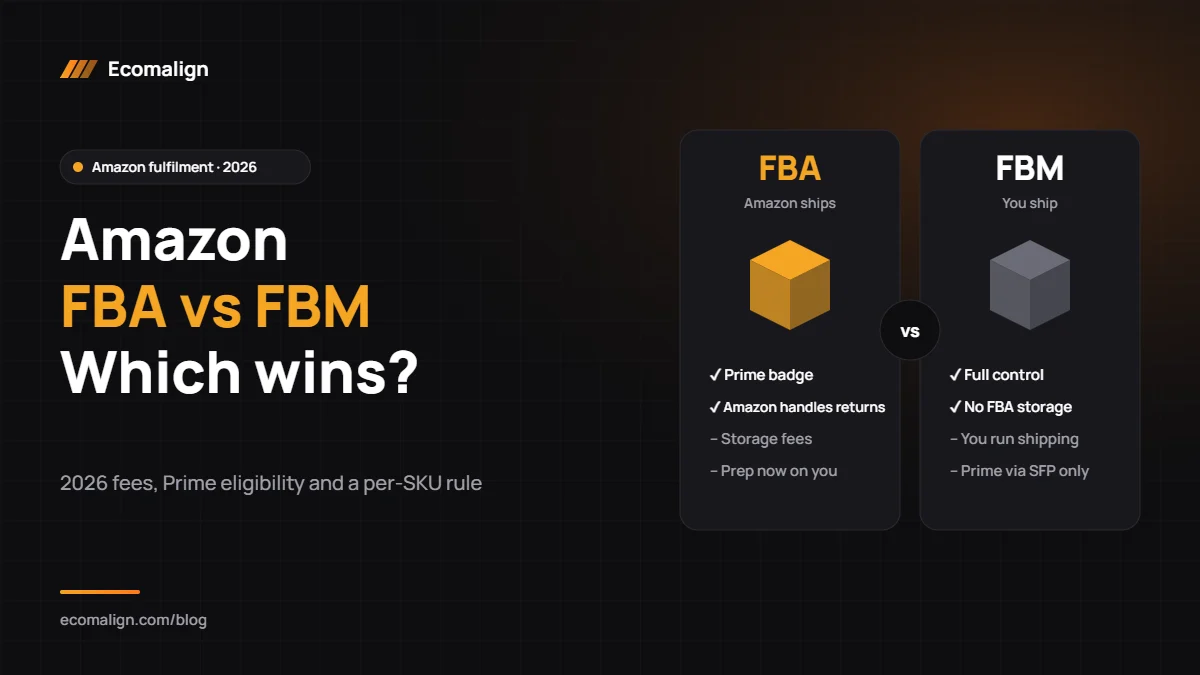
With FBA, you send inventory to Amazon fulfilment centres. Amazon picks, packs, ships, handles customer service and processes returns. With FBM, you or your 3PL handle all of that. A third option, Seller Fulfilled Prime (SFP), lets you ship yourself while showing the Prime badge, if you meet strict delivery performance targets.
| Factor | FBA | FBM |
|---|---|---|
| Prime badge | Yes, automatically | Only via Seller Fulfilled Prime |
| Who ships and handles returns | Amazon | You or your 3PL |
| Storage fees | Monthly and long-term storage fees | Your own warehouse cost |
| Control over packaging and stock | Limited | Full |
| Buy Box competitiveness | Strong | Depends on your delivery speed |
| Best for | Small, light, fast-selling items | Oversized, slow-moving, custom or high-margin items |
What changed for Amazon FBA in 2026?
Three changes shifted the maths this year:
- Fulfilment fees rose. From 15 January 2026, US FBA fees increased by an average of $0.08 per unit, with fees now tiered by price band (under $10, $10–$50, over $50) (Amazon 2026 fee announcement). Referral fees did not change.
- Prep services ended. Since 1 January 2026, Amazon no longer preps, labels or poly-bags inventory; sellers must ship compliant units or use a prep centre. Our FBA prep centre guide explains the options.
- A logistics surcharge arrived. From 17 April 2026, a 3.5% fuel and logistics surcharge applies to FBA fulfilment fees in the US and Canada (Amazon Seller Central).
The net effect: FBA is still efficient for most standard-size products, but thin-margin and low-priced items need a fresh profit check.
How much does FBA cost compared with FBM?
Compare cost per unit, not headline fees.
FBA cost per unit = referral fee + fulfilment fee + storage + inbound placement + prep + return processing.
FBM cost per unit = referral fee + postage + packaging + pick-and-pack labour + storage space + returns.
For a small, light item selling around $20, FBA is often $1–$2 cheaper per unit because Amazon’s shipping rates beat what most sellers can negotiate. For a bulky item that sells a few units a month, storage and oversize fees can make FBM several dollars cheaper.
When should you choose FBA?
- Products under about 1 kg (2 lb) that fit standard-size tiers
- Fast sellers that turn inventory within 60–90 days
- Competitive categories where Prime drives the Buy Box
- Sellers without their own warehouse team
When should you choose FBM?
- Oversized or heavy products with high FBA fees
- Slow movers where storage fees eat margin
- Handmade, made-to-order or bundled products
- Products also sold on eBay, TikTok Shop or Shopify from one shared stock pool (see multichannel inventory management)
- Backup listings when FBA stock runs out or capacity limits apply
The hybrid approach: decide per SKU
Stop treating FBA vs FBM as one company-wide choice. Run every SKU through three questions:
- Size and weight: small standard → lean FBA; oversize → lean FBM.
- Sales velocity: sells weekly → FBA; sells monthly or less → FBM.
- Margin after all fees: if FBA leaves under 15% net, test FBM or SFP.
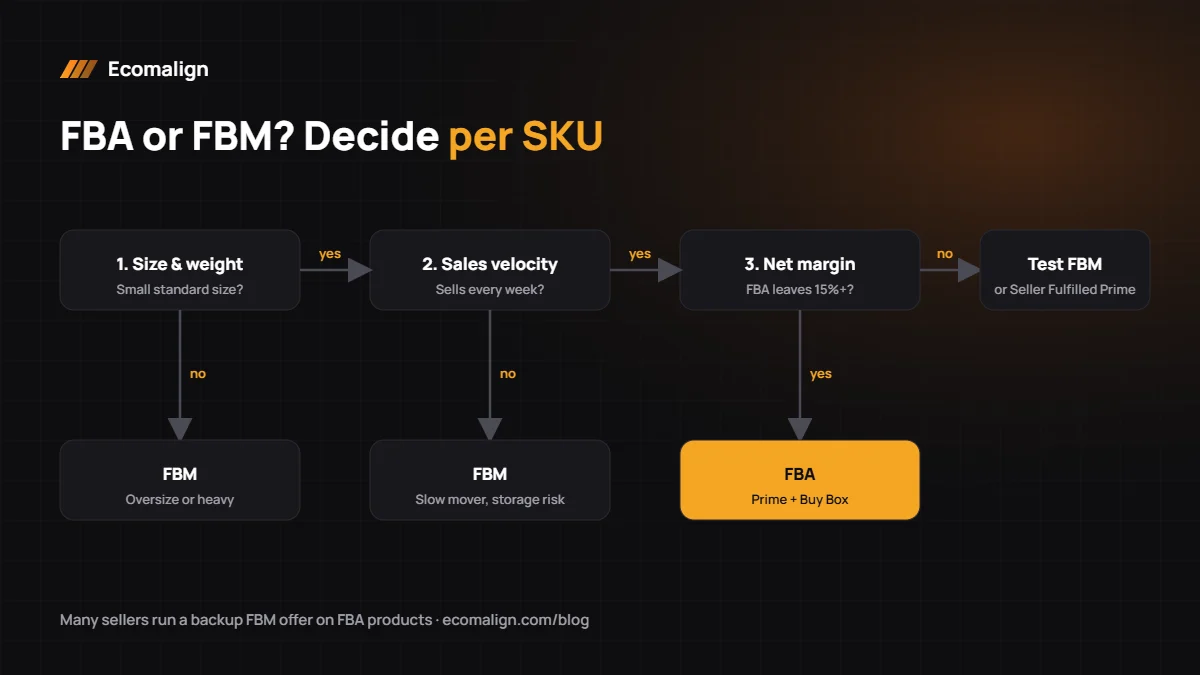
Many of our clients run fast sellers through FBA and keep a matching FBM offer live as a backup, so a stock-out does not kill their ranking. Whichever model you use, a well-built listing matters just as much; see our Amazon listing optimization guide.
How PREP Ecomalign supports both models
With Amazon’s prep service gone, a prep centre is now part of most FBA supply chains. PREP Ecomalign receives, inspects, labels, bags and ships inventory into FBA for the US, UK and Australia, and can fulfil FBM orders from the same stock. That gives you one inventory pool for both models. Learn more about our prep and fulfilment services.
FAQ
Is FBA or FBM better for beginners?
FBA is usually easier for beginners selling small items because Amazon handles shipping and customer service. Beginners with bulky or slow products should start FBM to avoid storage fees.
Can I use FBA and FBM at the same time?
Yes. You can run both on different products, or both on the same product as separate offers.
Does FBM get the Prime badge?
Only through Seller Fulfilled Prime, which requires fast delivery and high on-time performance.
Is Amazon FBA still worth it in 2026?
For small, fast-selling products, yes. The 2026 increases were modest on average, but low-priced and slow-moving items should be re-checked per SKU.
What does FBM mean on Amazon?
FBM means Fulfilment by Merchant: the seller stores, packs and ships orders instead of Amazon.
Not sure which model fits your catalogue? Book a free consultation with Ecomalign or call +971 56 542 4660.