

You know you are better.
Your work is stronger. Your clients are happier. Your prices are fair. You have been in the game longer, you care more, and anyone who has actually used your service knows it.
And yet there they are. Your competitor. Sitting above you on Google. Getting the calls, the clicks, the enquiries. Winning customers who have never even heard of you, simply because they showed up first.
It feels unfair. Because its kind of is.
But here is the truth nobody tells you: Google does not rank the best service. It ranks the best optimized one.
And once you understand that, everything changes.
Google Is Not a Quality Judge; It Is a Signals Reader
This is the single most important thing to understand about how search rankings work.
Google’s algorithm cannot walk into your office, watch your team work, compare your output to your competitor’s, and declare a winner. It has no way of knowing that your web designs are cleaner, your customer support is faster, or your results speak for themselves.
What it can read and what it ranks on are signals. Hundreds of them. Technical signals, content signals, authority signals, and experience signals. And if your competitor is sending stronger signals than you are, they win the ranking. Every single time. Regardless of who actually does better work.
The good news? Signals can be built. Rankings can be taken. And that is exactly what this article is going to show you.
Reason 1: Their Website Is Technically Healthier Than Yours
Before Google even looks at what your website says, it looks at how your website performs. And if your site has technical problems, your content does not matter, you are already starting from behind.
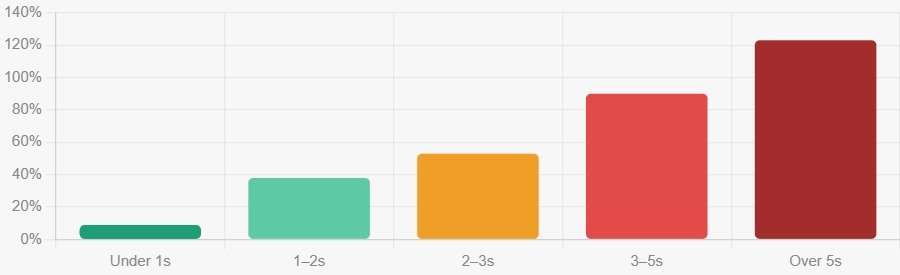
Page speed is the big one. Google has been using Core Web Vitals as a ranking factor since 2021, and the bar keeps rising. If your website takes more than 2-3 seconds to load, you are losing rankings and visitors simultaneously. Your competitor’s site loading in under a second is not just a better user experience; it is a direct ranking advantage over you.
Mobile responsiveness is non-negotiable. Google indexes the mobile version of your site first. If your website looks fine on a desktop but breaks on a phone with small text, overlapping elements or buttons that are impossible to tap, Google is penalizing you for it, even if most of your customers happen to find you on a laptop.
Crawlability matters more than most people realize. If Google’s bots cannot properly crawl and index your pages due to broken links, poor site structure, missing sitemaps, or incorrect robots.txt configurations, your pages simply do not show up no matter how good the content on them is.
Your competitor may not have better service. But they almost certainly have a cleaner, faster, more technically sound website. And in Google’s eyes, that counts for a lot.
How fast does your website load? Here’s what Google thinks of each speed
Reason 2: They Are Publishing Content. You Are Not.
Here is something that stings: Google rewards businesses that teach, not just businesses that sell.
Your competitor is probably running a blog. They are publishing articles that answer the exact questions your potential customers are typing into Google. “How much does a website cost in Pakistan?” “What is the difference between SEO and paid ads?” “How do I know if my management software is good enough?”
Every article they publish is another door into their website. Another opportunity to rank. Another chance to appear in front of someone who is actively searching for what they sell.
Meanwhile, your website has five pages; Home, About, Services, Portfolio, and Contact. Beautiful pages, maybe. But five pages is five opportunities to rank. Their thirty blog posts are thirty opportunities. The math is not complicated.
Content marketing is not about writing for the sake of writing. It is about strategically answering the questions your ideal customers are already asking and positioning your business as the expert that answers them.
Every article your competitor publishes while you are silent is a gap that gets harder to close.
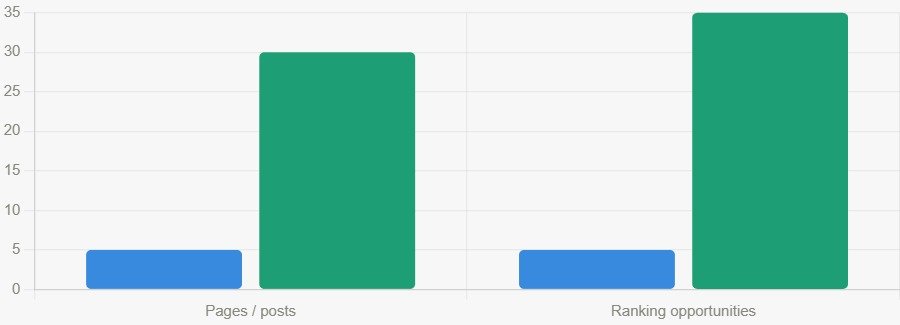
🟦Your website
🟩Competitor’s website
Reason 3: More Websites Are Linking to Them
This one surprises a lot of business owners.
Google treats links from other websites to yours like votes of confidence. The more credible websites that link to your directories, industry publications, local news, partner sites, and satisfied clients who mention you on their own websites, the more authority Google assigns to your domain.
This metric is called Domain Authority, and it is one of the most powerful ranking factors in existence.
Your competitor may have been building these links for years. Guest posts on industry blogs. Features in local business directories. Press mentions. Client testimonials that link back. Every one of these is quietly boosting their authority in Google’s eyes while your site sits with fewer links and lower authority.
The frustrating part is that you cannot build authority overnight. But you absolutely can build it consistently, and the businesses that start building it today will be the ones ranking at the top next year.
What actually drives Google rankings?
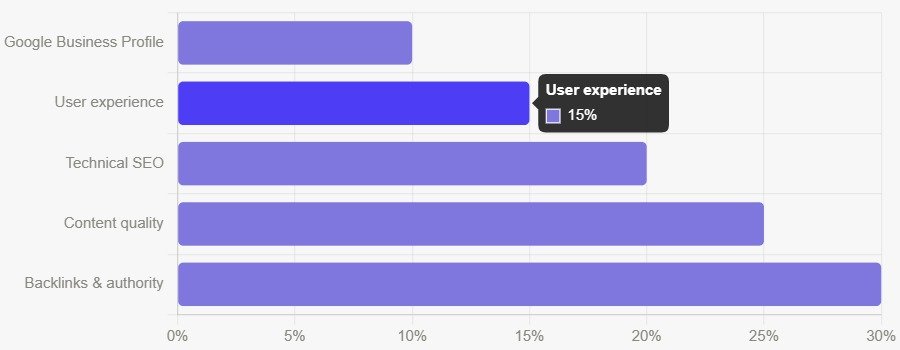
🟪Ranking factor weight
Reason 4: Their Google Business Profile Is Fully Optimized
If you are a local business and you are not obsessing over your Google Business Profile, you are leaving an enormous amount of visibility on the table.
Google’s local pack, the map results that appear at the top of the page for searches like “web design company near me” or “digital marketing agency in Lahore”, is driven almost entirely by your Google Business Profile, not your website.
Your competitor who ranks in that map section has probably done the following things you have not:
They have filled out every single field in their profile completely. Business hours, service areas, services offered, business description packed with relevant keywords, photos of their work and team, and a link to their website.
They are actively collecting Google reviews, and responding to every single one. Google treats review quantity, recency, and response rate as significant local ranking signals. Ten fresh reviews in the last month outweighs fifty old ones.
They are posting updates to their profile regularly, offering new services, and recent projects signaling to Google that this is an active, relevant business worth showing to searchers.
If your Google Business Profile is incomplete, has no recent reviews, and has not been updated in months, you are handing that local ranking to your competitor.
Reason 5: They Have Been Doing This Longer, But That Gap Is Closable
SEO is not instant. It is cumulative. A competitor who started optimizing their website, publishing content, and building links two years ago has a head start that feels unfair because it is.
But here is what that also means: the businesses starting their SEO effort right now will have that same head start over their competitors in two years. The question is not whether SEO takes time. It does. The question is whether you start building that advantage today or keep watching someone else collect your customers.
Google’s algorithm rewards consistency and longevity. Every month you invest in technical health, content, and authority is a month that compounds. The rankings you build do not disappear the way paid ads do the moment you stop spending.
This is the investment that pays forever.
SEO growth is cumulative; the earlier you start, the bigger your lead.
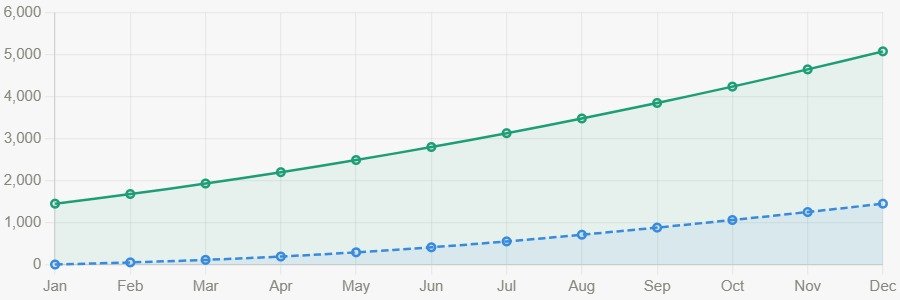
🟦You (starting now)
🟩Competitor (started 1 year ago)
What You Can Actually Do About It Starting Now
Understanding why your competitor ranks higher is only useful if it leads to action. Here is what closing that gap actually looks like:
Get a technical SEO audit done on your website. Find out exactly what is broken, slow pages, crawl errors, missing meta tags and poor mobile performance, and fix them systematically. You cannot outrank anyone with a technically broken website.
Start publishing content that answers real questions. Think about what your customers ask you before they hire you. Write detailed, honest, useful articles that answer those questions. Publish consistently. Every piece of content is a long-term ranking asset.
Build your Google Business Profile into a lead machine. Complete every field. Ask every happy client for a review. Respond to everything. Post updates weekly. This alone can move you into the local pack for searches that your competitor is currently owning.
Start building backlinks intentionally. List your business in every relevant directory. Reach out to local publications. Write guest articles. Get your clients to mention you online. Every link is a vote that builds your authority over time.
Track everything. You cannot improve what you do not measure. Set up Google Search Console, monitor your keyword rankings, watch your organic traffic, and review your Core Web Vitals regularly. Data tells you where to focus.
The Uncomfortable Truth and the Opportunity in It
Your competitor is not beating you because they are better. They are beating you because they understood something earlier: that in 2025, the businesses that win online are the ones that treat their digital presence as a serious, ongoing investment, not a one time task.
The gap between where you are and where you want to be on Google is not a talent gap. It is an execution gap. And execution gaps can be closed.
Every day your competitor sits above you is a day their head start grows a little bigger. But every day you start building a technically sound website, consistent content, growing authority, and optimized local presence is a day you are closing that gap.
The question is not whether you can outrank them.
The question is whether you start today or keep watching them take what should be yours.